
Is your marketing job safe from AI?
The real question isn’t whether AI will “take” marketing jobs — it’s which parts of your role are changing right now, and what you should be doing about it. Find out in 2 minutes.
2 minutes · No signup required · Built by a working AI instructor, not a research firm
LIVE PREVIEW
3
Free AI tools
~2 min
Average assessment time
0
Spam emails
100%
Actionable results
Marketing isn't "safe" or "at risk" — it's both, depending what you do day to day
Marketing sits in an unusual spot. Some of the work that used to fill a marketer’s week — first drafts of ad copy, basic performance reporting, routine social posts, keyword research — is now genuinely faster and often better with AI in the loop. That’s not speculation; it’s already happening in most marketing teams.
But the parts of the job that actually move a business — deciding what a brand should sound like, reading a market shift before the data confirms it, knowing which campaign will land with a specific audience and which will fall flat, managing the relationships that get a campaign approved and funded — none of that is something AI does for you. It still needs a person who’s good at judgment, not just execution.
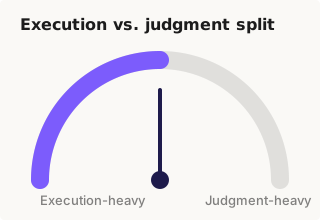
The honest answer to “is my marketing job safe” depends on how much of your current role is execution versus judgment. This assessment is built to show you exactly where you sit, not to scare you or reassure you with a generic score.
What's actually happening in accounting right now
51%→87%
Of marketers use generative AI in at least one workflow, up from 51% just two years ago (Salesforce).
-23% / +21%
Junior copywriting roles contracted 23% in 2025 while marketing data analyst roles grew 21% — opposite directions, same profession.
53% / 9%
Of marketers think AI will eliminate more marketing jobs than it creates industry-wide — but only 9% worry about their own role.
Source: Salesforce State of Marketing 2026, Digital Applied AI Marketing Statistics, Marketing AI Institute 2025, HubSpot AI Trends 2026
What this means for you:
the useful question was never “does my company use AI” — almost every company does now. It’s whether your specific day-to-day work looks like the execution-heavy roles that are contracting, or the strategic, judgment-heavy roles that are growing.
What this assessment looks at
The split between executional tasks (writing, reporting, scheduling) and judgment-based tasks (strategy, positioning, stakeholder decisions) in your current role
How comfortable you already are using AI tools in your daily marketing work
How much of your week is spent on repeatable tasks versus tasks that change every time
Your seniority and team context — a solo marketer, a specialist on a large team, and a marketing manager face different versions of this question
What's actually happening in accounting right now
AI-assisted now
Faster, often better, with AI doing the first pass
- Drafting first-pass ad copy and headline variations
- Pulling and summarizing campaign performance numbers
- Generating initial social media post drafts
- Basic keyword and competitor research
- Writing routine email subject line variations
- First drafts of briefs and reports
Still human-led
Judgment about brand, budget, or people — AI isn’t close here
- Deciding brand voice, tone, and positioning
- Explaining why performance changed and what to do next
- Reading a market or audience shift before the data confirms it
- Choosing which campaign idea is actually worth funding
- Managing internal stakeholder buy-in and approvals
- Building and maintaining client or customer relationships
The pattern: AI is fastest at the first draft and the first pass. It’s not making the calls that carry risk or require judgment about people, brand, or budget — and it’s not close to doing that yet.
What this looks like in practice
CONTENT PRODUCTION
Producing vs. directing
A junior copywriter’s traditional workload — first-draft ad copy, routine social posts — is now largely AI-assisted, which is reflected directly in the contracting headcount data for junior production roles. The marketers moving up are the ones directing that output, not just producing it.
STRATEGY & POSITIONING
Summarizing vs. deciding
AI can summarize competitor messaging and generate positioning options. A senior strategist still decides what the brand should actually stand for and defends that judgment to leadership — the kind of work behind the 18% growth in senior content strategist roles.
PERFORMANCE ANALYSIS
Reporting vs Explaining
AI pulls and summarizes campaign numbers instantly. A marketing data analyst still explains why performance shifted and what it means for the next campaign — exactly the judgment-heavy analytical work behind the 21% growth in that role.
What's worth building next
If your assessment shows more of your role shifting toward AI-assisted work, these are the skills that keep you ahead of that shift rather than behind it.
Strategic positioning and brand judgment
The work AI drafts but can't decide, and the fastest-growing senior marketing skill set.
Data interpretation, not just reporting
Explaining why numbers moved, not just summarizing that they did.
AI tool direction, not just AI tool use
Becoming the person who directs AI output toward a strategic goal, not just the person producing more of it.
Stakeholder and budget judgment
Deciding which campaign is actually worth funding, a decision that stays entirely human.
Closing your own training gap
Since 68-70% of marketers get no formal AI training from their employer, the marketers pulling ahead are largely self-directed.
Your result comes with a specific next step
This isn’t a score for the sake of a score. Based on your result, you’ll get pointed to the specific guide or skill path that matches your actual gap — whether that’s getting more fluent with AI tools day-to-day, or sharpening the strategic and judgment-based skills behind the marketing roles that are actually growing.
Want the fuller picture first?
GUIDE
AI Skills That Actually Matter in 2026
A practical look at which AI capabilities are worth developing for modern marketing work — not another list of 50 tools.
Check another role
AI’s impact looks different in every function. If you work closely with other teams, it’s worth checking their risk profile too.
Is My Project Manager Job Safe from AI?
Get Your Team’s AI Readiness Score (Marketing)
Which AI Skill Should You Learn Next?
If This Is Bigger Than Just You
For individuals
Coaching
If your assessment showed specific gaps, one-on-one coaching builds practical AI skills over time with structured guidance and real-world application to your actual work.
For teams
Team training
If your whole accounting or finance team is facing this shift, team training is built around your team’s actual tools, workflows, and challenges — not a generic AI 101 course.
FAQ
Common questions
Will AI replace marketing jobs?
Not evenly across the profession. The data shows a real split: junior copywriting and production roles saw real headcount reductions in 2025, while senior content strategist, marketing data analyst, and AI-native marketing engineer roles all grew double digits. It’s less “marketing vs. AI” and more “execution work vs. strategic work.”
Why do only 9% of marketers worry about their own job, if 53% think AI will eliminate marketing jobs overall?
This is a well-documented perception gap — people tend to see systemic risk in their industry more clearly than personal risk in their own role. It’s worth taking seriously in both directions: don’t panic based on the industry-wide number, but don’t assume you’re automatically exempt either. That’s exactly the gap this assessment is built to close with a role-specific answer.
Which marketing roles are most affected by AI right now?
Junior copywriting and content production roles have seen the most direct headcount pressure. Senior strategic roles — content strategy, marketing data analysis, AI-native marketing engineering — are growing, not shrinking, because that work depends on judgment AI doesn’t have.
What marketing skills are safest from AI?
Brand strategy, campaign judgment, stakeholder management, and the ability to interpret why something worked or didn’t. These require context and judgment AI doesn’t have, and they’re exactly the skills behind the marketing roles currently growing.
How is this different from a generic AI job risk checker?
Most AI risk tools give you a single occupation-wide score pulled from broad labor statistics. This assessment looks at what you actually do day to day, and connects your result to a specific, practical next step — a guide or training path built from real workplace experience, not just a number.
Do I need to already use AI tools to take this?
No. The assessment works whether you’re an AI beginner or already using it daily — the questions and results adjust to where you’re starting from.