AI Readiness Score
12 quick questions across 3 areas: prompt engineering, tool selection, and workflow automation. Answer honestly — this isn't a test, it's a starting point.
Your AI Readiness Score
What's Your AI Readiness Score?
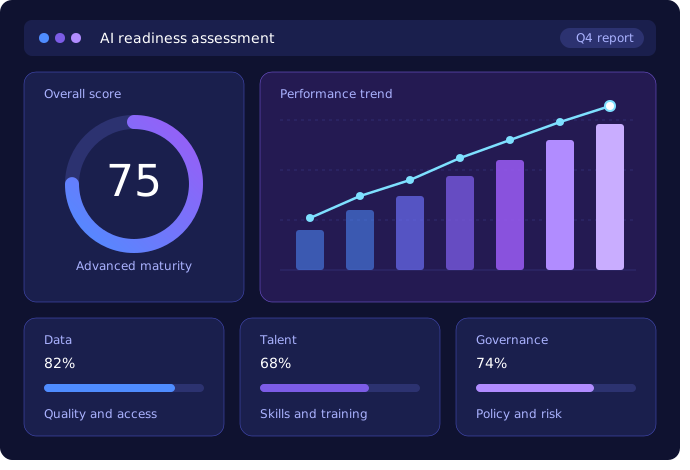
39% of core job skills are expected to change by 2030. Only 23% of professionals feel prepared. This free AI Readiness Score assessment tells you exactly where you stand and what to actually do about it.
2 minutes · No signup required · Built by a working AI instructor, not a research firm
LIVE PREVIEW
3
Free AI tools
~2 min
Average assessment time
0
Spam emails
100%
Actionable results
The gap isn't about whether AI is coming. It's about whether you're ready.
Almost everyone has used an AI tool by now. That’s not the interesting question anymore. The interesting question — the one this AI Readiness Score assessment actually answers — is whether you’ve built the underlying skills and habits that turn “I use AI sometimes” into “AI genuinely makes me better at my job.”
The data shows a real gap here. The World Economic Forum projects 39% of workers’ core skills will change by 2030, but only 23% of professionals currently feel adequately prepared to work effectively with AI. And the people who close that gap aren’t rewarded lightly for it — workers who can demonstrate real AI-related skills earn up to 56% more than peers without them, according to PwC’s Global AI Jobs Barometer.
This free assessment measures where you actually stand across the things that predict whether AI helps you or just adds noise to your day — not a vague “AI maturity” label, but a specific, practical readout. Use this personal AI check to understand your current AI Readiness Score and identify the skills you can work on next.
What the data actually shows
39% / 23%
Of workers’ core skills expected to change by 2030 (WEF) — but only 23% of professionals feel adequately prepared.
56%
Higher earnings for workers who demonstrate real AI-related skills versus peers without them (PwC).
144%
YoY growth in job postings requiring AI skills — 51% of them now sit outside traditional IT roles.
Source: World Economic Forum Future of Jobs Report, PwC Global AI Jobs Barometer, Bipartisan Policy Center / Lightcast
What this means for you:
the wage premium and career advantage are real, and most people haven’t captured them yet. The gap isn’t tool access — almost everyone has that now. It’s the underlying readiness this assessment measures.
What this assessment looks at
Tool fluency — genuine working comfort with AI tools relevant to your actual work, not surface familiarity
Verification discipline — do you check AI output, or trust it by default?
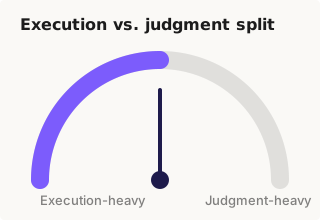
AI Readiness Score Direction skill: Are you using AI to produce more, or to make better decisions?
Training investment — are you closing your own skills gap deliberately, or hoping it closes itself?
Human-skill balance — are judgment, communication, and relationship skills staying sharp, or quietly eroding?
Adaptability — how quickly could you pick up the next wave of AI tools relevant to your work?
What the difference actually looks like
Low AI readiness score
- Uses AI tools inconsistently, without a real process
- Trusts AI output by default, rarely verifies it
- Uses AI to produce more output, without a clear goal behind it
- Hasn’t noticed judgment or communication skills getting rusty
- No formal training, and hasn’t sought any out independently
- Would struggle to adopt the next new AI tool quickly
High AI readiness score
- Has real working fluency with the AI tools relevant to their work
- Verifies AI output as a habit, not an afterthought
- Directs AI toward specific outcomes and decisions
- Deliberately protects and builds the human skills AI can’t replace
- Actively closes their own training gap, employer-provided or not
- Adapts to new AI tools quickly because the underlying skill is there
The pattern: the difference isn’t how much AI someone uses. It’s whether the six dimensions above are actually in place underneath that usage. That’s exactly what separates the people capturing the wage premium and promotion advantage from everyone else using the same tools with none of the results.
What this looks like in practice
VERIFICATION
Sending vs. checking
Two people use the same AI tool to draft a report. One sends it as-is. The other checks it against what they actually know, catches an error the tool introduced, and sends something genuinely reliable. Same tool, completely different outcome.
DIRECTION
Producing vs. deciding
One person asks AI to “make this longer” or “write me five options.” Another gives AI a real goal — a decision they’re trying to reach — and uses the output as a starting point for their own judgment. The second approach is what separates using AI from being directed by it.
TRAINING
Waiting vs. building
One person waits for their company to roll out formal AI training. Another spends 20 minutes a week building AI fluency on their own. Given that most professions show a majority of workers get no formal training at all, only one of these people is actually closing the gap.
Closing the gap, dimension by dimension
If tool fluency is your gap
Pick one AI tool relevant to your actual work and go deep, not wide.
If verification is your gap
Build the habit of checking AI output before it becomes second nature to skip it.
If direction is your gap
Practice giving AI a real decision to help you reach, not just a task to complete.
If human-skill balance is your gap
Deliberately spend some of your AI-reclaimed time on judgment, communication, and relationship work.
If training is your gap
Treat your own AI literacy as a deliberate project, since most employers still aren't providing it.
Your AI readiness score comes with a specific next step
This isn’t a score for the sake of a score. Based on your weakest dimension, you’ll get pointed to the specific guide or training path that actually closes that gap.
Want the fuller picture first?
GUIDE
AI Skills That Actually Matter in 2026
A practical look at which AI capabilities are worth developing for modern accounting and finance work — not another list of 50 tools.
Check something more specific
This is the general readiness score. For a sharper answer, check the version built for your exact situation.
If you want structured help closing the gap
For individuals
Coaching
One-on-one coaching builds practical AI skills and improves your AI readiness score over time with structured guidance and real-world application to your actual work.
For teams
Team training
If your whole team needs to close this gap together, team training is built around your team’s actual tools, workflows, and challenges — not a generic AI 101 course.
Common questions
What's the difference between this and the role-specific assessments?
This measures your general AI Readiness Score across six dimensions that apply to almost any job. The role-specific assessments (marketing, HR, sales, and others) go deeper on how AI is specifically changing that one function. Many people find it useful to check both — this one for the broad picture, the role-specific one for the details.
Is this assessment for individuals or teams?
This version is built for individuals. If you’re assessing a whole team’s readiness, the team-specific variants (like the Marketing Teams version) measure organizational dimensions — data, governance, process — that this individual version doesn’t cover.
Why does verification matter so much in this assessment?
Because the data consistently shows it’s the most commonly skipped step. Across research on developers, accountants, and other professions, people who verify AI output by default get measurably better and safer results than people who trust it automatically — and most people currently don’t verify by default —making this habit crucial for a high AI readiness score.
Do I need to already be using AI tools to take this?
No. The assessment works whether you’re an AI beginner or already using multiple tools daily — the questions and results adjust to where you’re starting from.
How is this different from a generic AI maturity quiz?
Most generic quizzes measure tool usage alone, which is close to universal now and doesn’t tell you much. This assessment measures the six dimensions that actually predict whether AI use turns into real results — verification, direction, human-skill balance, and more — not just whether you’ve opened a chatbot.
What is AI Readiness Score ?
AI Readiness Score is the Most generic quizzes measure tool usage alone, which is close to universal now and doesn’t tell you much. This assessment measures the six dimensions that actually predict whether AI use turns into real results — verification, direction, human-skill balance, and more — not just whether you’ve opened a chatbot.