
Which AI Skill to Learn Next
7 quick questions about your role and how you already use AI. You'll get one specific skill to focus on — not a generic course list.
Which AI Skill to Learn Next? Find Your Best Path
Not a list of 50 tools. Get one specific, personalized recommendation based on your actual role, your current gaps, and where the data says the real leverage is to decide which AI skill to learn next.
2 minutes · No signup required · Built by a working AI instructor, not a research firm
LIVE PREVIEW
3
Free AI tools
~2 min
Average assessment time
0
Spam emails
100%
Actionable results
More AI tools isn't the answer. More confusion usually is.

84% of business leaders say there are already too many AI tools available, and it’s causing real confusion and overlap for employees, according to a Canva-commissioned Harris Poll survey of over 1,300 CIOs. Choice overload is a documented psychological effect — beyond a certain number of options, more choices increase anxiety and push people toward avoiding a decision entirely rather than making one.
That’s exactly what’s happening to a lot of well-intentioned professionals right now. They know they should be “doing something” with AI, so they bookmark another tool, try another app, read another “top 10 AI tools” list — and end up with a scattered stack that adds friction instead of removing it. Meanwhile, 95% of enterprises report seeing no measurable ROI from their AI investments, according to research — a strong signal that accumulating more tools was never the real bottleneck.
This assessment does something different: it doesn’t hand you another generic list. If you’re struggling to decide which AI skill to learn next, this tool looks at your actual role and current gaps to give you one specific, actionable skill to focus on — the single thing most likely to move the needle, based on the same patterns we’ve found researching how AI is changing nine different professions.
What the data says about tool overload
84%
Of business leaders say there are already too many AI tools available, causing confusion and overlap (Canva / Harris Poll).
95%
Of enterprises report no measurable ROI from AI spending, despite 88% using AI in at least one function (McKinsey).
54.6%
Of US adults had adopted generative AI by August 2025 — a crowded, competitive landscape of tools and advice for everyone.
Source: Canva / Harris Poll CIO Survey, McKinsey AI adoption research, Harvard Kennedy School Project on Workforce
What this means for you:
the bottleneck for most people isn’t tool access — it’s clarity on which one thing is actually worth focused effort. That’s the specific gap this assessment is built to close.
What this assessment looks at
Your role and the specific tasks that make up most of your week help determine the right AI skill to learn next.
See where you currently stand across core AI skill areas like tool use, verification, and direction, and get a clear path on which AI skill to learn next.
What's actually holding you back right now — a skills gap, a confidence gap, or a direction gap
Your time and learning style — a realistic recommendation accounts for what you can actually commit to
What the difference actually looks like
Instead of another generic tool list, here are the tracks this assessment uses to show you which AI skill to learn next. Almost everyone’s real next step falls into one of these.
Foundational Fluency
For people who haven’t built real working comfort with any AI tool yet. The goal isn’t breadth — it’s depth with one tool relevant to your actual work.
Verification & Judgment
For people already using AI but trusting the output too readily. One of the most commonly skipped skills — and one of the highest-leverage.
Direction & Prompting
For people who use AI to produce more, but haven’t learned to direct it toward a specific decision. The shift from junior to senior AI use.
Human-Skill Amplification
For people whose AI-assisted work is solid, but whose judgment, communication, or relationship skills could use deliberate attention.
Team & Leadership Adoption
For people managing others through this shift — building the shared process, governance, and training a team actually needs.
The pattern: most people’s real bottleneck is one specific track, not a general lack of AI knowledge. Finding which one saves months of scattered, low-leverage effort.
What this looks like in practice
FOUNDATIONAL
Casual use vs. real depth
Two people use the same AI tool to draft a report. One sends it as-is. The other checks it against what they actually know, catches an error the tool introduced, and sends something genuinely reliable. Same tool, completely different outcome.
VERIFICATION
Skipping review vs. building the habit
A developer who uses AI-generated code regularly but skips review half the time gets a specific recommendation to build a review habit — the single highest-leverage change available to them right now.
DIRECTION
Drafting vs. deciding
A project manager who uses AI to draft reports but hasn’t connected that to actual decision-making gets pointed toward practicing “direction” — giving AI a real judgment call to support, not just a task to finish.
One skill, not a new to-do list
Treat the recommendation as a filter, not an addition
The point is to stop chasing every new tool and focus on the one thing that's actually your bottleneck right now.
Give it real time before switching focus
Choice overload happens partly because people abandon a skill before it compounds — depth beats breadth here.
If direction is your gap
Revisit the assessment in a few months
If human-skill balance is your gap
Your gap moves as your skills do; this isn't a one-time label.
Pair the skill with the matching guide
Not a generic course — your result links to the specific resource built for that exact track.
One recommendation, not fifty options
This assessment exists specifically because more tools and more lists were making the problem worse, not better. You’ll get one clear next step — not a menu to choose from.
Want the fuller picture first?
GUIDE
AI Skills That Actually Matter in 2026
A practical look at which AI capabilities are worth developing for modern accounting and finance work — not another list of 50 tools.
Check something else too
Is My Marketing Job Safe from AI?
AI Readiness Assessment for Marketing Teams
If you want structured help building it
For individuals
Coaching
One-on-one coaching builds practical AI skills over time with structured guidance and real-world application to your actual work.
For teams
Team training
If your whole team needs to close this gap together, team training is built around your team’s actual tools, workflows, and challenges — not a generic AI 101 course.
Common questions
Why does this give me one skill instead of a list?
Because the data suggests lists are part of the problem. 84% of leaders say there are already too many AI tools causing confusion, and choice overload is a well-documented pattern that increases anxiety and decreases action. One clear, specific recommendation is more useful than ten options to evaluate.
How do I decide which AI skill to learn next for my career?
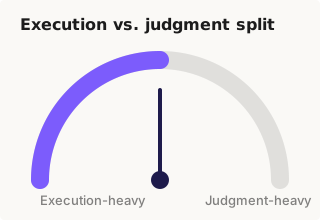
To figure out which AI skill to learn next, evaluate your current daily tasks and identify whether you spend more time on execution or decision-making. Taking a personalized assessment will help you focus on the exact high-leverage AI skill that matches your role rather than trying to learn every new tool.
How is this different from the AI Readiness Score?
The Readiness Score gives you a broader picture across six dimensions. This tool goes one step further and gives you a single, specific skill to prioritize first — useful when you already sense you need to do something, but aren’t sure what.
Do I need to already use AI tools to take this?
No. The assessment works whether you’re just starting out or already juggling multiple tools daily — the “Foundational Fluency” and “Human-Skill Amplification” tracks exist for exactly those different starting points.
Why is it important to know which AI skill to learn next instead of just trying new tools?
Learning every new app leads to tool fatigue and choice overload. Knowing which AI skill to learn next allows you to build deep, high-value capabilities—like judgment, prompt engineering, or verification—that deliver real productivity gains and long-term ROI.